| |||||||||||||||||||||||||||
| |||||||||||||||||||||||||||
|

J.R. Mooney Galleries of Fine Art: Art Tips, Reviews, Fine Art, and Custom Framing News
Showing posts with label salinas. Show all posts
Showing posts with label salinas. Show all posts
Saturday, August 2, 2014
New Arrivals


Friday, July 12, 2013
W.A. Slaughter vs. Randy Peyton Bluebonnet wars
Bluebonnet landscape paintings have been revered, prodded
and poked, coveted and chastised; an ongoing joke of over-produced Sunday
painters- a favorite category to paint of “holiday” painters.
However, the history of such a genre of painting has deep
roots in Texas and especially San Antonio. Home to the great blue bonnet
painters like the Onderdonks, Salinas, Wood, Slaughter and a small legion of
others, Texas takes pride in its namesake in Art History, knowing it has
inspired these great artists to produce such magnificent work.
Along with this museum collected success story comes positive
growth of this art form with subsequent generations of painters that have
studied the Texas State flower masters and excelled the painting style to new
levels; clearing the way for bluebonnets to be well-respected within the
artistic landscape of modern painting.

Randy Peyton
In a compare and contrast study, two paintings back-to-back
by master painter W.A. Slaughter and sought after contemporary painter Randy
Peyton show a time honored scholarly application of technique, application, and
compositional study; with Peyton playing the role of student as he methodically
mimics the aesthetics of a signature impressionistic painting.
Slaughter’s rolling countryside landscape eases down into a
valley, exposing the rustic rooftop of a barn; weathered from decades and
decades of sun drenched Texas weather. Peyton’s rooftop shows same pitch, same rustic
quality, adding modern amenities like a metal roof and chimney, but unchanged, the
rolling angles of land work in the same manner- providing movement for our eye
to follow as we move from foreground to background in both paintings.
Live Oaks spot the sun bleached Texas grasses with Slaughter’s
painted in more subtle approach with minimal contrasts in shadow and detail,
while Peyton’s stark shadows create more depth- showing the tree’s character.
Slaughter’s bluebonnets are more like the original Onderdonk
style, with cool blues spotted with white highlights, while Peyton’s bluebonnets
demand more attention. They are painted
text-book Impressionistic, but are detailed in a way that anchors them more to
the ground than Slaughter’s.

W.A. Slaughter
Cactus litter the ground in both paintings, but again detail
and shadow are treated different; each artist giving grace to the solar
qualities of light, playing color on color with more emphasis on the direct
sunlight, its angle in the sky and the projected shade it transmits onto the
vegetation around it.
The Texas sky, a signature trait of these parts is often portrayed
as ever expanding. However, Slaughter
attacks his heavens with billowing clouds that compliment his overall painterly
palette. But, Peyton’s hard edged
aesthetic does not lend itself to a detailed atmosphere. Peyton’s clouds lack the softness projected
by Slaughter’s applications. On the other hand, owning his own style, Peyton
works in his own artistic voice while paying homage.
And not in any way to be overlooked, Peyton has indeed
studied intently on artists like Slaughter and Onderdonk, among others, and his
dedication to craft has proven a successful career in the fine arts.
Now semi-retired, Peyton might one day sit among the great
blue bonnet painters of Texas as the next generation attempts to tackle such a
widely recognizable Texas icon.
Look for both paintings available for sale at J.R. Mooney
Galleries of Fine Art.
© Gabriel Diego Delgado
Texas Landscape
W.A. Slaughter
Oil
16 x 20
$5,250.00
Grand Oak
Randy Peyton
Oil
16 x 20
$1,745.00
Monday, June 18, 2012
See a wonderful article by Michael Grauer titled, " Texas Impressionism, 1885-1935"
From an exhibition at the Panhandle-Plains Historical Museum
http://www.facebook.com/media/set/?set=a.316511298436866.75504.100002339960067&type=3&l=0b2d43010b


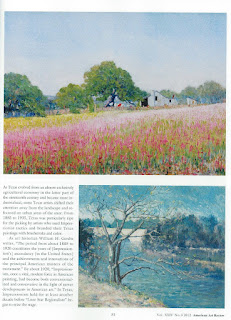


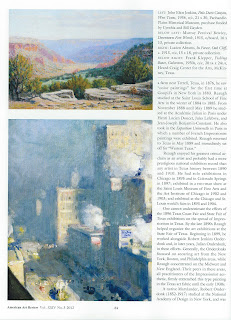


From an exhibition at the Panhandle-Plains Historical Museum
http://www.facebook.com/media/set/?set=a.316511298436866.75504.100002339960067&type=3&l=0b2d43010b
This is an an article about Texas Impressionism which
covers some of the artists J. R . Mooney Galleries has
handled in the past
June 2012 edition of American Art in Review


Thursday, June 7, 2012

“Blooming Cactus”
Porfirio
Salinas
Oil
16 x 20
New to the selections of great paintings at J.R. Mooney
Galleries of Fine Art San Antonio location is a wonderful Masterpiece by the
Renowned Early Texas Artist Porfirio Salinas, titled: Blooming Cactus. Although this pictorial
desert is not a typical coveted bluebonnet painting; ones that are routinely sought after,
“Blooming Cactus” is a gem of its own.
A mostly monochromatic desert-scape spotlights the lonely
world of a cactus bush; secluded by itself on a winding pathway deep in the Texas Hill
County Salinas captures the early morning light with
subtle shadows and mountainous misty haze.
On the right hand of the pictorial plane sits the blooming
cactus of orange and red flowers, soaking up the daytime sun. Evening-out the
compositional scale is a ragged, non-leaved dry brush on the left side, showing
varied undergrowth that is characteristic of Texas climates. The title references the foreground
vegetation, but the visual focus is primarily the snaking and trodden rocky
pathway- winding back, off into an unobservable curve and over a knoll. Salinas peaks our
interest with what is around that unseen corner and into the oblivion. As viewers, we know this is a heavily
traveled path by the degree of impression on the dirt and rock; alluding to
various needs to make the travels.
In analyzing the painting, we see that Salinas is very aware of his middle ground as
well as his background. There is a repeated motif of outcrops of branches that
jet out well above their spatial limitations that show character; both on the
left side of the pathway, exposing naked branches and slightly bloomed foliage.
Fifty yards beyond the foreground cactus plant exists a
small cropping of cactus that looms in the mid-ground; a spotty undergrowth
that adds much needed pathway jump of color. The orange dots of paint on this
visually suppressed cluster allow the viewers’ eye to move deeper into the painting;
bring hue and lively conversation between the two.
Adding to the market value of “Blooming Cactus” is the
artist’s signature. Salinas
has a very clean and recognizable signature on lower left corner; something
that is favorable to all collectors.
-Gabriel Diego Delgado
Call the gallery at 210-828-8214 to ask about pricing.
Or come on by the gallery and see the painting in person at
8302 Broadway , San Antonio ,
TX 78209.
Subscribe to:
Posts (Atom)