Showing posts with label Artist. Show all posts

Tuesday, November 17, 2015

Art Consultant Spotlight: "Roadrunner and Cactus" by Helen Hunter


Helen Hunter’s “Roadrunner and Cactus” is an intimate depiction of the regional bird in its habitat. The bird looks frail but strong and stands erect next to a blooming prickly pear cactus, possibly its nesting ground. Hunter’s roadrunner is alert, concentrating on something just beyond the reach of the canvas. It could be a predator, or possible a juicy insect about to become the bird’s next meal. The peril is not revealed to the viewer but the feeling of fight or flight remains. It is a glimpse, a rare view that catches a moment in the wild and beautiful world of the surrounding Texas countryside.

©Gina Martinez, Art Consultant, J.R. Mooney Galleries, Boerne,TX
Please Contact J.R. Mooney Galleries of Fine Art for Availability and Pricing
1.800.537.9609 Toll Free
210.828.8214 San Antonio, TX Location
830.816.5106 Boerne, TX Location

Thursday, February 27, 2014

Lost Maple Path, landscape painting by Margie Barker


Lost Maple Path
Margie Barker
Acrylic
$659.00
20" x 24"

In a painting entitled, Lost Maple Path, Margie Barker finds inspiration from her love of the land and a tribute to Lost Maples State Park, located at Vanderpool, Texas.  Margie shares her view artistically with the viewer; reminding us of times past while  enjoying picnicking, backpacking, sightseeing, hiking, bird watching and nature studying.

The rough terrain of rocks and shallow creek form the visual base of the painting.  Small saplings show new growth, vigor and adaptability in the rocky yet sheltering environment.  The arrangement of rocks is elliptical, a shape that juxtaposes the foliage of the stately central maple tree.  

The tree is radiant with natural fall color and jubilant as only nature can create.  The hillside is prolific with greens foliage and slopes downward.

Margie paints the golden yellow and maple red-orange leaves of this tree so one might enjoy the sky laden with gentle wispy white clouds. She paints the beauty of the hillside and the composition of nature with layer upon layer of vibrant color and shadow.  

 Nature is at its abundant best and Margie uses the paint and brush to tell the story. There is a walking path that beckons and the short shadows indicate plenty of time to enjoy the discovery of views only steps away.

The colors chosen are powerful in this painting and the organization is rhythmically inviting.  Margie Barker has successfully captured a moment in time as she adventured to the Texas Hill Country.

By: Betty Houston
Art Consultant
JR Mooney Galleries, Boerne

To purchase call 830-816-5106

Or purchase online at www.jrmooneygalleries.com

Tuesday, July 23, 2013

Tragedy of a Neo-Expressionist

Neo Expressionism -- a continuation or progression from the Abstract Expressionism movement aligns with similar ideologies, characteristics and aesthetics of the American claimed school; color intensity, automatic painterly response to automatic drawing, emotional color outpours, and full body gestures.

From color field painting to action painting, the New York artists of 1940’s- 1960’s made a name for themselves after World War II.

C. Nesvadba


Neo Expressionists took to presenting more recognizable subjects, but still dealing with topics and themes in an emotionally charged approach, relying on remarkably intense hues and studious color compositions.

The artwork of Christian Nesvadba celebrates all that is Neo Expressionism, with his semi abstract flower compositions that seem to emit a radiant botanical bounty of color.

Draped in bloodshot crimson and powerful reds, Nesvadba’s color palette invigorates an emotional response.

In Abstract in Multicolors, puffs of light blue and yellow ochre highlights bounce around the inflamed hues that electrify the composition, giving us refreshing bursts of playfulness among intense emotional repose.

Slate greys, muted muddiness and absence of color anchor the painting -- a heavy blanket covering the lower half that make the upper rubicund section seem to float; held up by the black gestural lines within the thick haze of palette scrapes and brashness.

Although the selections appear to be bouquets of flowers, Nesvadba conceals their identity in abstract amorphousness. The squiggles, automatic mark making and linear scribbles attach themselves to the base of the ambiguous blobs, reminiscent of a Cy Twombly-like fashion of writing.

With a life, cut short by a tragic fatal car accident, Christian Nesvadba’ s paintings will only escalate in value due to his signature look, quality of work, and shortened exhibition history – including solo exhibitions in Salzburg and Linz, and a select showing at the  Galerie Otto in Vienna.

© Gabriel Diego Delgado/  J R Mooney Galleries


Christian Nesvadba
Abstract in Multicolors
24” x 31”
$4,815 w/frame
Oil on Canvas

Friday, July 13, 2012

Jung Yoon


Jung Yoon
Morning’s First Light
48” x 60”
Oil

By:
Gabriel Diego Delgado
Art Consultant
J.R. Mooney Galleries of Fine Art

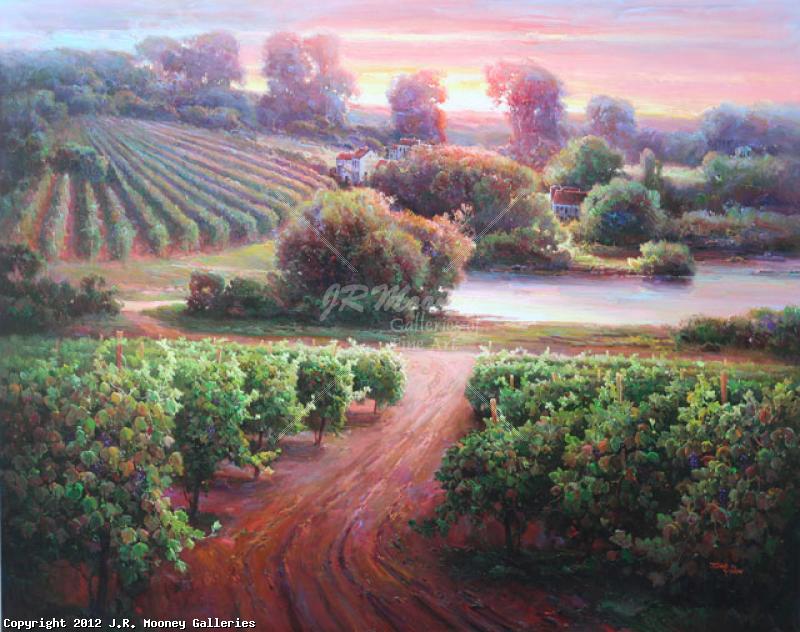
..."Jung Yoon, aka (Max J. Yoon) a Korean Painter and former Bass Guitarist for Korean Pop Superstar Patti Kim, is a master of the superficial sunlight; exaggerating the ornately clouded sunrays of optimism and sumptuousness.  Yoon creates striking landscapes where the ground plays “second fiddle” to the intense rays of light emitting from behind the clouded atmosphere of superficial sunsets and dawning.

Morning’s First Light is no exception. A simple four quadrant composition and central path and tree cluster- the gestalt of the painting rests solely on the predawn luminosity that scatters across the vineyards and orchards of some imaginary estate.  Part Thomas Kincaid, part Venetian Impressionism- Yoon’s signature is seen in the golden rays that disperse a multi value palette of pinks, crimsons, blues, oranges, and purples across the semi-obstructed skyline.

Although the pathway leading into the center of the composition is a bit flat, the acute angles of the chateau on the upper left pulls your attention into the shadowy corner of celestial cerulean.  Deep in the heart of the off-centered conundrum of lavishly overgrown trees, a manor peeks out from behind the over simplistic vegetation.

Playing off the homestead viewpoint, Yoon interjects with a seemingly misplaced lake. Bland in his color intensity, the water emits a cool and refreshing feeling-even if there is little effort in his attempts to capture the true essence of the morning radiance in the reflections.

Even though each section of the painting has its place in the composition and anchored to its position by deliberate visual breaks, there are no surprises in the quasi-autumn scenery but the beaming joie de vivre of aura and divinity."

Jung Yoon
Morning's First Light
Oil
48 x 60"

Wednesday, July 11, 2012

Jose Vives-Atsara


..."Known for his peasant scenes, this “woman in the market” is exemplary in the fact that our sensibility of this individual can be assessed even without seeing her face. Our understanding her existence or impoverishment can be calculated by the fact she is in the marketplace selling her commodities under a tarp, sitting on the ground.  Additional still life elements are introduced to the left of the subject matter by way of various editable selections and containers.  Vives’s careful attention has been paid to the folds of the fabric as well as the braid in her hair."
-Gabriel Diego Delgado
Art Consultant
JR Mooney Galleries
www.jrmooneygalleries.com


"Mujer en el Mercado"
oil
Jose Vives-Atsara
$15,000 U.S.D


-Jose Vives-Atsara was born in Vilafranca del Panades in the Catalonian region of Spain on April 30, 1919. As a small boy he loved to sketch with pencil and paper. He began painting at the age of eleven. His first one man show came at the age of fourteen. From that time on, painting has been his love and his way of life.

Jose studied art at Saint Raymond College and the School of Fine Arts in Barcelona. He claimed that his most inspirational teacher was nature itself.

Mr. Vives-Atsara came to San Antonio in 1956. Within twenty years, he became one of Texas's most distinguished artists. His use of a palette knife in painting allowed him to blend rich pure pigments into a powerful statement of color directly on the canvas. This style produced works that are distinctively Vives-Atsara.

Jose is represented in such collections as the Museum of Modern Art, Spain; Fort Worth Art Museum, Texas; His Royal Highness Juan Carlos, King of Spain; the Vatican; the State Capitals of many southern states of the United States. His work is also in many private collections in the United States, Spain, Mexico and Venezuela.

For many years Jose was in great demand as a lecturer and teacher. He was the Artist-In-Resident at Incarnate Word College, San Antonio, Texas. Although Mr. Vives-Atsara studied with many well-known European teachers, he insisted that he was continually learning about painting, and throughout his life his range of subjects continued to grow. The great intensity and character he captured from the people of Mexico, the depth and strength of the colors in his florals, and his breathtaking Texas landscapes manifested an interest and acuteness of mood too infrequently found in artists.

 -excerpt from www.jrmooneygalleries.com


Tuesday, July 10, 2012

Arthur McCall New Work July 2012


Arthur McCall


Written By: Gabriel Diego Delgado
Art Consultant
J.R. Mooney Galleries 

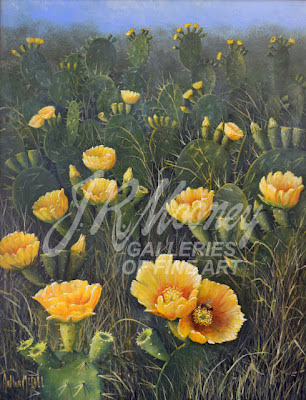
The True Texan and artist, Arthur McCall is back with two new smaller works.  Each one is simplistic in genre but detailed for investigation. Fowl, Vegetation, Cactus and Foliage all mix within two small paintings that hold the viewers attention. 

In McCall’s Searchin’- Wild turkeys searching for victuals in the light underbrush show their eager persistence in scouring the ground to make the meal. Details in the feathers, ground textures and dried up riverbed situates the viewer in the unknown but slightly familiar acreage- one of the days long ago when Father and son happen upon the game in a outdoor manly bonding retreat.  Accompanying the intrinsic detail of the work we cannot help but hear the gobble of the birds as they peck and forage.  Plus, we see the water is not yet stagnant, feeding life of those in this semiarid desert climate.  On the otherhand,


Arthur McCall’s “Yellow Cactus” illustrates a picturesque field of voluptuous cactus, reveling in the afternoon sun. Stretching beyond what the eye can see - this infinite field of cactus is complete with a pollinating honeybee, cherishing the sweet succulents of these golden Texas Treasures.

http://www.jrmooneygalleries.com/McCall,%20Arthur
"Searchin"


http://www.jrmooneygalleries.com/McCall,%20Arthur
"Yellow Cactus"


Thursday, July 5, 2012


Dalhart Windberg, "Yucca Cactus"
By: Gabriel Diego Delgado
Art Consultant
J R Mooney Galleries

..."This horizontal painting by the world renowned Dalhart Windberg, is a 60’s throwback to a time of a palated aesthetic. This orange, garish, and post-apocalyptic landscape is complete with barren branches of broken vegetation that references the Pencil (stick) cactus; bookending a vital cactus patch.  Approaching such a diminishing acute angle, the flowered cactus in the foreground start at a higher depth at the left side, diminishing in perspective or measurable volume as the painting reads left to right. The viewer’s connection breaks at a cluster of spiky Yucca cactus on the right; a dark and shadow ridden vegetation that caters to the brazen fire-burning skyline of insidious haze.  Windberg’s palette knife strokes make for choppy and slanted textures on the rocks and stones. Although this creates a somewhat muddy color field; the application works w
ith the motifed application of knife and brush- such is the example of the cactus themselves.  Usually Windberg pays careful attention to shadows, light, color, and values, but in “Yucca Cactus” his play on shade turns to gloom as he investigates the “un-penetrate-able” crevices that lurk in the midst of such undergrowth.  Unusual in his decision to add such a secondary color as the main hue, this painting is a gem, unique to his roster of paintings and surely a collector’s item in its own integrity."

JR Mooney Galleries
8302 Broadway
San Antonio, TX
210.828.8214

www.jrmooneygalleries.com

Tuesday, June 19, 2012

J. Morgan in his studio in Korea....


This pic was sent to us by his dealer who 


was with us for a few hours talking 


about Morgan's new work, as well as a 


several other Korean painters..


Contact:
Gabriel Diego Delgado
Art Consultant
J. R. Mooney Galleries of Fine Art / 8302 Broadway / San Antonio, TX. 78209 / 210.828.8214


Thursday, June 14, 2012

How to Choose the Right Custom Framing for Your Art


Framing Your Art


-Gabriel Diego Delgado
San Antonio

When choosing to frame your treasured piece of art, there are so many choices to choose from.  Do you go with a mat or a double mat, do you go with a large or small frame, and do you include fillets or “lips”? (And what are those!). Do you include acid-free backers, acid free mat board; or conservation glass, museum glass, conservation non-glare, Plexi-glass®, UV coated glass, or regular glass? All these questions and more can be answered by your local framing shop experts. But, let’s begin to answer some of these questions to get you started.

First and foremost, a frame should always compliment the artwork as well as protect it.
Although the type of frame is a personal choice, framing design consultants are valuable assistants in deciding how to frame; offering suggestions on color schemes, color theory, and differences in backers, mats and frames.

Although traditionally, picture frames are primarily made out of wood, but there are many alternatives in today’s market that include silver, bronze, aluminum, and plastics; while older frames commonly are a combination of wood with 3-D plaster appliqués.

The first thing that might be asked when framing your artwork is: “How do you want to mat the art?”  A mat is a piece of malleable and flexible board; typically of cotton fiber- whether it is paper, rag board or a combination of paper and cloth. This mat is ideally a neutral based accent that has one cut opening or “aperture” that acts as a window to the artwork- drawing the viewer’s eye into the image. It is not unusual to see a double or triple mat when dealing with photographs and thicker works of art.  A fillet, a decorative liner or cloth covered wood moulding that is used in-between or underneath mats, can be used for added aesthetic, increasing the space between the framing glass and the art.

The space behind the glass is very important in framing.   If space does not exist between the surfaces, the natural occurrence of environmental water condensation can inadvertently be absorbed into the artwork. If the water has no room to evaporate, it can cause mold and damage the art.

Then there is the question of the glass itself, and what kind and why.   Will the art be in indirect or direct sunlight? What are the types of lights being used to accent the work of art- fluorescents, natural, or combination? Will the art be in a museum, gallery, or private viewing? All these answers will play a role in the glass selection. However, with each quality grade of glass, the price point always increases. Single-pane glass is the cheapest choice with Museum Grade glass being the most expensive.  Museum Glass attains an antiglare quality with all the archival qualities of UV protection, while single-pane only adds a physical barrier.   Keep in mind there are many choices in-between these two extremes like conservation glass, conservation non-glare, acrylic blends like Plexi-glass®, and others. Be sure to discuss all the options with your local expert framing designer.

Now that you have decided which mat to use and how many; which frame, and what kind of glass, we need to think about the back of the frame. The backer can vary widely; ranging from no support- if you’re framing a stretched canvas to a use of foam-core boards, to simple paper liners. Dustcovers are often used to close off the internal space as well as cover any cardboard or foam core backing, keeping dust, bugs, and other harmful elements out.

Remember, the more questions you ask to your local framing expert, the happier you will be with the final product.


Contact:
Gabriel Diego Delgado
Art Consultant
J. R. Mooney Galleries of Fine Art / 8302 Broadway / San Antonio, TX. 78209 / 210.828.8214


One of our expert custom framers 


Taking care of the details


Making sure custom framing is flawless


Custom cut glass for a museum exhibition


Piecing together a custom framing corner

Thursday, June 7, 2012

Mooney Makes Sense Launches in Boerne Business Monthly

With the Help of Boerne Business Monthly, J.R. Mooney is launching an advice column titled Mooney Makes Sense

       http://bluetoad.com/publication/?i=114657

(this link is a direct connection to the new June edition as an online magazine viewer)

This advice column will touch on a wide array of topics, including everything from types of artist reproductions, conservation, genres of art, how and where to buy art, reasons for collecting, etc.  

Each month Boerne Business Monthly will run a new advice column of Mooney Makes Sense for your enjoyment.

Look for more tips and advice from the experts in the field.

Thank you Boerne Business Monthly!

See the first edition of Mooney Makes Sense in the Boerne Business Monthly at:


****Our advise column is on page 26-27***


or visit their website at http://www.boernebusinessmonthly.com/ and view the June 2012 edition.


Contact:
Gabriel Diego Delgado
Art Consultant
J. R. Mooney Galleries of Fine Art / 8302 Broadway / San Antonio, TX. 78209 / 210.828.8214